
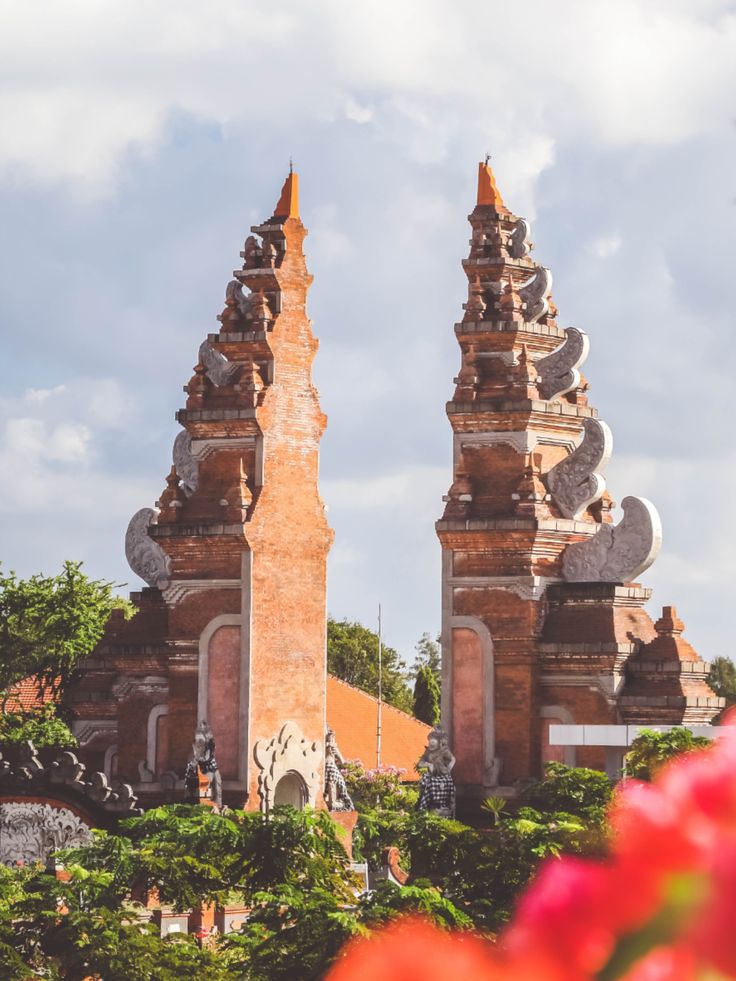
If you scroll through any Instagram feed about Bali, you will see it. A perfectly symmetrical, soaring gateway that looks like a mountain sliced cleanly in half, framing a volcano or the ocean. This is the Candi Bentar (Split Gate).
From the famous “Gates of Heaven” at Lempuyang to the grand entrances of Nusa Dua, these gates are icons of the island. But why are they split? And why is there no roof connecting them?
The answer lies in an ancient myth about the creation of Bali itself—a story of gods, mountains, and the balance of the universe.
Cultural Insight: Candi Bentar
The Name: Candi (Temple/Shrine) + Bentar (Split/Broken). The Shape: Resembles a sacred mountain cut perfectly in two. The Function: It is the “outer gate,” marking the transition from the chaotic outside world into a holy sanctuary. The Lesson: You must leave your negativity and worldly ego outside before you enter.
The Mythology: Lord Shiva and Mount Meru
According to ancient Balinese manuscripts, the island of Bali was originally unstable and floated in the ocean. To fix it, the gods decided to move the summit of Mount Meru (the sacred mountain of the universe in Hindu cosmology) from India to Bali to act as an anchor.
During the journey, Lord Shiva, the Destroyer and Transformer, saw that the massive mountain was too heavy to carry as one piece. With a strike of cosmic power, he split the mountain into two perfect halves.
- One half became Mount Agung (the masculine/father mountain).
- The other half became Mount Batur (the feminine/mother mountain).
The Candi Bentar represents this mythological event. When you walk through the gate, you are literally walking through the sacred mountain of the gods, entering a space of balance between the masculine and feminine, the earthly and the divine.
Why No Roof? The Connection to Heaven
Unlike Western gateways or arches which are closed at the top, the Candi Bentar is always open to the sky. This is not just an aesthetic choice; it is deeply philosophical.
The split sides represent the material world—the physical reality we live in. But the open space in the center represents the void, or the direct channel to the heavens (Swah Loka). By leaving the gate open at the top, the Balinese ensure that the connection between the temple ground and the gods above is never broken or obstructed.
Rwa Bhineda: Finding Balance
Just like the Saput Poleng (checkered cloth), the Split Gate is another physical representation of Rwa Bhineda (balance).
The two halves of the gate are identical, mirror images of each other. They symbolize the opposing forces of the universe: Good and Evil, Joy and Sorrow, Male and Female. Neither side is higher or larger than the other. They stand in perfect equity.
The lesson for the visitor is simple: To pass through the gate safely and enter the holy ground, you must find your own inner balance. You must walk the “middle path,” centered between these opposing forces.
Capturing the Moment
The next time you pose for a photo at a Candi Bentar—whether it’s at a famous temple or right here at the entrance to our Nusa Dua sanctuary—remember the story.
You aren’t just standing in a doorway. You are standing in the center of a split mountain, grounded by the earth, open to the sky, and perfectly balanced in the middle of the universe.
Discover More Myth & Magic in Our Cultural Guide