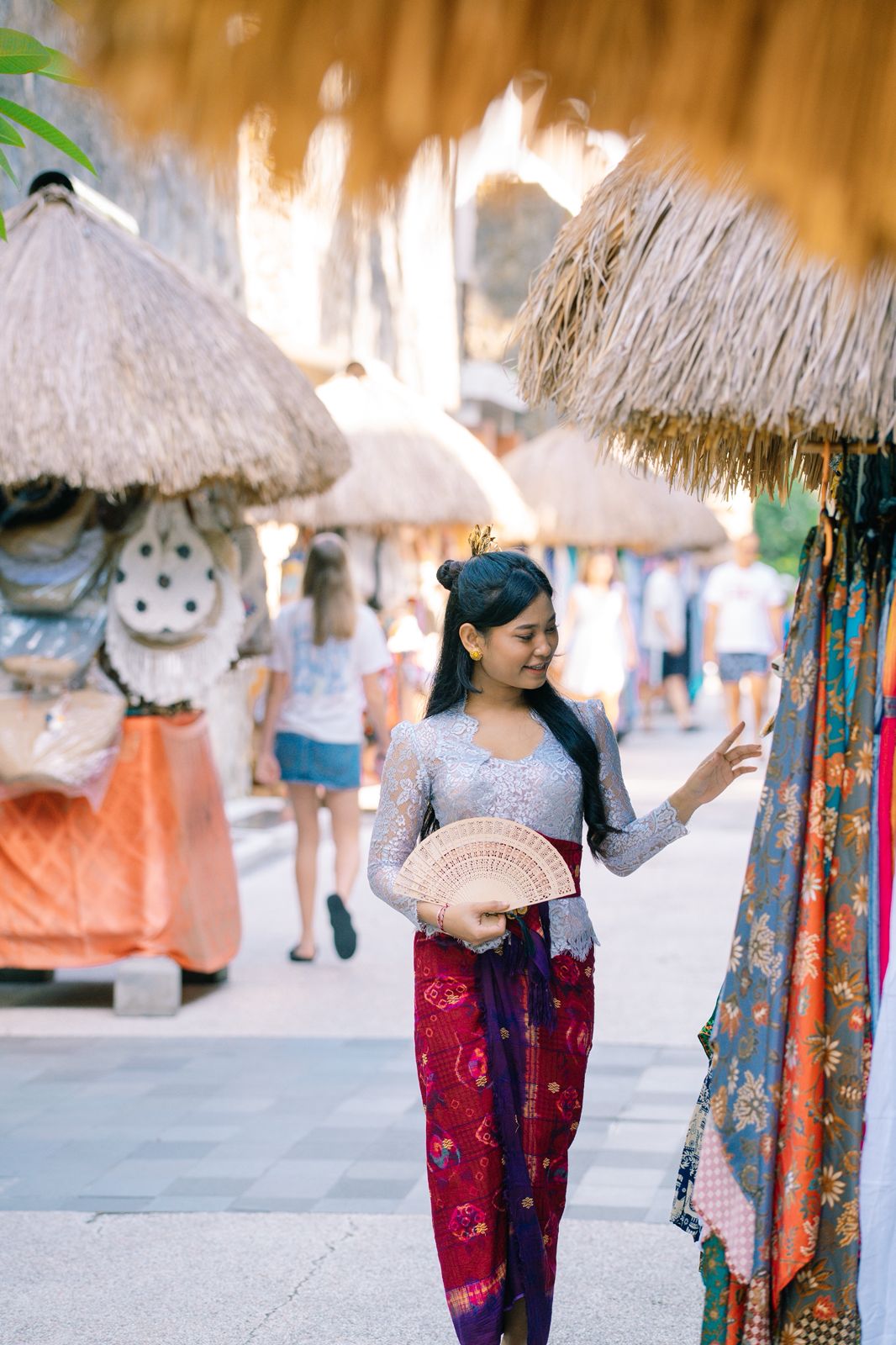
If you walk through the streets of Denpasar on a Tuesday, or attend a formal Balinese event, you will notice something striking. The locals aren’t wearing the famous Javanese Batik. Instead, they are draped in a fabric that shimmers with vibrant colors and geometric patterns, looking both ancient and incredibly modern.
This is Endek.
While Batik often steals the spotlight on the international stage, Endek is the true “Fabric of Bali.” Once reserved strictly for kings and high priests, today it is a symbol of Balinese pride.
If you are looking for the perfect, authentic souvenir to take home—one that supports local heritage and looks stunning—Endek is the answer. Here is the story behind the cloth.
Cultural Insight: Endek
The Name: Derived from Gendek or Ngendek, meaning to remain/stay (referring to the color staying on the tied threads). The Technique: Weft Ikat (Tie-dyeing the threads before they are woven). The History: Originally reserved for Balinese nobility and royalty. Best Souvenir: A handmade Endek sarong, scarf, or shirt.
A Cloth Fit for Kings
History tells us that Endek flourished during the reign of the Gelgel Kingdom in Klungkung around the 16th century. For hundreds of years, this wasn’t a fabric for the common people. It was a status symbol.
Certain motifs and colors were strictly restricted. The Patra and Encak Saji motifs, for example, were reserved solely for high-caste nobility and royalty. To wear Endek was to display power, prestige, and sacred connection.
Today, those rules have relaxed. Endek has become the “national uniform” of Bali, worn by government officials, hotel staff, and locals attending weddings. But it has never lost its royal aura. When you wear Endek, you are wearing a piece of history.
The Magic of “Ikat”: How It’s Made
What makes Endek so special (and expensive) compared to printed fabrics? It is the incredible difficulty of the Ikat (meaning “to tie”) technique.
Unlike a print, where a design is stamped onto a finished cloth, the pattern of Endek is created before the weaving even begins.
- Tying: The weaver ties tiny knots into the bundles of thread.
- Dyeing: The threads are dipped in dye. The tied parts resist the dye, keeping their original color.
- Weaving: This is the magic moment. As the weaver works the loom, the dyed threads slowly align to reveal the pattern.
It is a process that requires mathematical precision and months of patience. If the threads shift by even a millimeter, the pattern blurs.
How to Spot the Real Deal (Buyer’s Guide)
Bali’s markets are flooded with cheap, machine-printed imitations. If you want to support a local artisan and own a true piece of art, here is how to tell the difference:
- Look at Both Sides: This is the easiest test. Real woven Endek is reversible—the pattern looks the same on the front and back. If the back is faded or white, it’s a factory print.
- Touch It: Real Endek has texture; you can feel the individual threads crossing. Prints feel smooth and flat.
- Check the Edges: Handmade Endek will often have a “selvedge” (a finished edge) with slight irregularities, proving it was made by human hands, not a giant machine.
Bringing a Piece of Bali Home
Buying a piece of Endek is one of the most sustainable ways to support the island. You are keeping a centuries-old craft alive.
- For Your Home: An Endek runner looks stunning on a dining table.
- For Your Wardrobe: A tailored Endek shirt or a simple scarf adds a touch of “Bali Chic” to any outfit, whether you are in New York, Sydney, or Jakarta.
We invite you to look closer at the uniforms of our team here at Merusaka, or explore the local boutiques in Nusa Dua. You might just find a pattern that speaks to you.